
Of all the questions an Indian divorcing couple brings to a family lawyer, the loudest is almost always the same: how much? How much maintenance every month, how much in lump sum, how much for the children, how much for how long.
Indian alimony law is widely misunderstood on this question, partly because there is no single statute that covers it and partly because there is no formula. What there is — and what the Supreme Court has repeatedly clarified, most recently in Kiran Jyot Maini v. Anish Pramod Patel (July 2024) — is a multi-factor framework that courts apply case by case.
This article unpacks the framework, the underlying statutes, the different kinds of maintenance available, the rough rules of thumb judges use, and the realities most lawyers will tell you only in private.
The statutes that matter
Maintenance and alimony in India sit across several laws, depending on the religion and the type of relief:
- Hindu Marriage Act, 1955 — Section 24 (interim maintenance and litigation expenses during proceedings) and Section 25 (permanent alimony post-divorce). Applies to Hindus, Buddhists, Jains, Sikhs.
- Special Marriage Act, 1954 — Equivalent provisions for civil and inter-faith marriages.
- Indian Christian Marriage Act, 1872 and Indian Divorce Act, 1869 — Maintenance for Christians.
- Parsi Marriage and Divorce Act, 1936 — For Parsi marriages.
- Muslim Women (Protection of Rights on Divorce) Act, 1986 — For Muslim women, with the Supreme Court's Shah Bano jurisprudence now layered with Mohd. Abdul Samad (2024) confirming Muslim women can also claim maintenance under the general law.
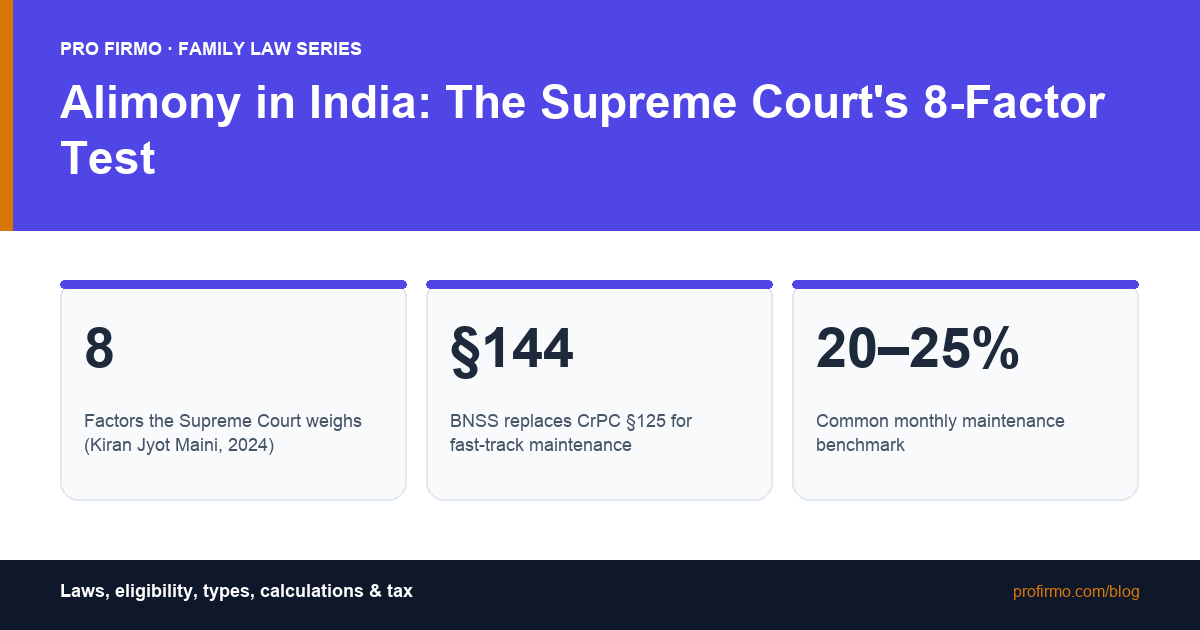
- Bharatiya Nagarik Suraksha Sanhita, Section 144 (replacing CrPC Section 125 from 1 July 2024) — A summary, secular, religion-blind right to maintenance for wives, children, and parents who cannot maintain themselves. Used in parallel with the personal-law remedies above.
- Protection of Women from Domestic Violence Act, 2005 — Monetary relief under Section 20 covers maintenance plus actual losses (rent, medical, etc.).
In practice, the lawyer's first question is almost never which Act to use, but which combination — most live cases use the personal law for the divorce itself, BNSS 144 for fast monthly maintenance, and the DV Act where applicable for protective monetary relief.
Who can claim — and from whom
The classical picture is the dependent wife claiming from a working husband. Indian law has moved beyond it. As things stand in 2026:
- A wife — by far the most common claimant. Both during and after divorce.
- A husband — yes, the Hindu Marriage Act is gender-neutral on Section 25. A financially dependent husband whose wife earns substantially more can and does claim. Awards are still rare but no longer rejected on grounds of gender.
- Children — until majority, often beyond if studying or unable to maintain themselves.
- Parents — under BNSS Section 144, dependent elderly parents can claim from a child who can maintain them. Used more than people realise.
The Supreme Court's 8-factor framework
The single most important reference point in 2026 is the 8-factor framework the Supreme Court has been articulating since Rajnesh v. Neha (2020) and restated in Kiran Jyot Maini v. Anish Pramod Patel (July 2024). The Court has been emphatic that these are guidelines not a "straight-jacket formula." The eight factors are:
- Social and financial status of the parties.
- Reasonable needs of the wife and the dependent children.
- Qualifications and employment status of the parties.
- Independent income or assets owned by the applicant.
- Standard of living enjoyed by the wife in the matrimonial home.
- Employment sacrifices made by the wife for family responsibilities.
- Reasonable litigation costs for a non-working wife.
- Financial capacity of the husband, his income, his obligations, his liabilities.
The principle behind the framework, the Court emphasised: alimony "should not penalise the husband" but should be "made with the aim of ensuring a decent standard of living for the wife."
The types of maintenance, in plain English
- Interim maintenance (Section 24 HMA / equivalents). Paid during the proceedings, often within weeks of filing. The court orders this so the dependent spouse can survive the litigation.
- Permanent alimony (Section 25 HMA / equivalents). Awarded as part of the divorce decree, either as a lump sum or recurring monthly payments.
- Lump sum settlement. A one-time, final amount. Common where the parties want a clean break and the paying spouse can afford it.
- Monthly maintenance. Recurring, indexed informally to inflation in many decrees, payable until remarriage of the recipient or death.
- Rehabilitative maintenance. Time-bound support to help a dependent spouse retrain and become self-sustaining. Used especially when the dependent spouse is younger and capable of re-entering the workforce.
- BNSS Section 144 maintenance. Fast, summary, magistrate-level monthly maintenance. Often the first cash flow a separated spouse sees.
Calculations — the rough rules of thumb
There is no statutory formula. But court orders in the metros tend to cluster around some informal benchmarks:
- Monthly maintenance: courts often start around 20 to 25 percent of the paying spouse's net take-home income, adjusted up for dependent children and a long marriage with full-time homemaking, adjusted down where the receiving spouse has their own income or earning capacity.
- Lump sum settlements: commonly land somewhere between one-fifth and one-third of the paying spouse's net worth, again depending on the length of the marriage and the dependant's age and earning capacity.
These are not legal rules. They are the patterns lawyers see. The actual decree depends on the eight factors above, the specific judge, and the specific facts.
Tax — who pays what
A point that surprises many people:
- Lump sum alimony is a non-taxable capital receipt in the recipient's hands.
- Recurring monthly maintenance is taxable as income in the recipient's hands.
- Asset transfers as part of a settlement: the assets themselves transfer tax-free, but any future income from those assets is taxable in the recipient's hands.
This has a real planning consequence — for many couples, a slightly smaller lump sum can be more valuable to the recipient than a larger monthly stream, and a similarly attractive deal for the payer.
Modification — orders aren't forever
Either spouse can apply to the family court for modification when there is a substantial change in circumstances. Common triggers:
- The payer loses their job or suffers a serious illness.
- The recipient remarries (often ends the obligation entirely).
- The recipient's income changes substantially.
- The children's circumstances change (turning 18, finishing studies, etc.).
Failure to pay an alimony order is enforceable as contempt of court; wage garnishment and bank-account attachment are routine.
State variations and judicial culture
The personal laws are central, but the local judicial culture shapes outcomes in real ways. Delhi courts often lean into matrimonial lifestyle as the benchmark. Tamil Nadu courts have a strong line on property rights and maintenance for the wife. Kerala courts foreground child welfare and elderly-parent maintenance. Mumbai's family courts have set the pace on rapid interim relief.
The five things every claimant should bring to their first meeting with a lawyer
- Marriage certificate.
- Last three years of ITRs from both spouses (or your own, if you don't have your spouse's yet).
- Salary slips for the last 6 months from both sides.
- A simple monthly-expense log of the household, on a back-of-envelope basis.
- A list of major assets and liabilities in both names.
Walk in with that, and the lawyer can usually give you a credible quantum range within an hour.
This article is general information about Indian maintenance and alimony law and is not legal advice for your specific situation. Statute, judicial culture, and tax positions evolve; consult a family lawyer in your jurisdiction before acting.
Found this useful? Share it.