
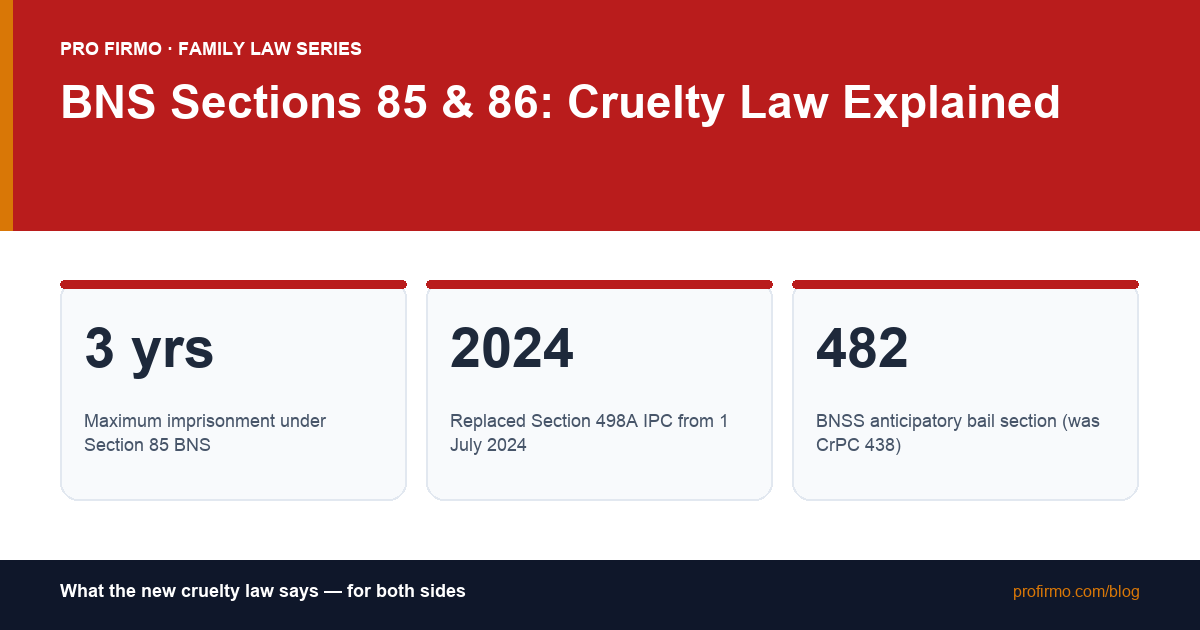
For more than four decades, the cruelty law most Indians vaguely knew the number of was Section 498A IPC. Mention it in any drawing-room conversation about a troubled marriage and people had an opinion — either as a shield abused women genuinely needed, or as a weapon misused against in-laws. From 1 July 2024, that section is gone. In its place sit two new sections of the Bharatiya Nyaya Sanhita: Section 85 (the offence) and Section 86 (the definition).
The substance of the law hasn't changed. The numbers have. And alongside, several procedural shifts under the new Bharatiya Nagarik Suraksha Sanhita have changed how the process actually plays out. This article walks through both sides — what the law now says, and what to do whether you're the person bringing the complaint or the person it's been brought against.
What Sections 85 and 86 actually say
Section 85, BNS reads: "Whoever, being the husband or the relative of the husband of a woman, subjects such woman to cruelty shall be punished with imprisonment for a term which may extend to three years and shall also be liable to fine."
Section 86, BNS defines "cruelty" as:
- Any wilful conduct of such a nature as is likely to drive the woman to commit suicide, or cause grave injury or danger to life, limb or health (mental or physical); or
- Harassment with a view to coercing the woman or any person related to her to meet any unlawful demand for property or valuable security, or because of failure to meet such a demand.
This is, almost word-for-word, what Section 498A IPC used to say. The legislative drafters preserved the substance; they restructured the code. Anyone who tells you the new law has "weakened" or "strengthened" the offence has not actually read the sections side by side.
The procedural changes that do matter
While the offence is the same, three procedural shifts under the new criminal codes matter in real cases:
- Preliminary inquiry before arrest is now the norm. Following the Supreme Court's guidance in Rajesh Sharma v. State of UP (2017) and Arnesh Kumar v. State of Bihar (2014), and reinforced by BNSS provisions, police are expected to verify the complaint — typically through a Family Welfare Committee or a designated officer — before making arrests in 85/86 cases. The days of automatic, same-day arrest of the husband and in-laws are largely over.
- Bail-friendly framework. Sections 85 and 86 are cognizable and non-bailable, but anticipatory bail is routinely granted by High Courts where the complaint shows no overt act of grave violence, and where the accused cooperates with the inquiry.
- Section 144 BNSS replaces Section 125 CrPC. Maintenance for the wife (and children, parents) continues to be a fast civil-criminal remedy, now numbered Section 144. The substance is identical: monthly maintenance, summary process, no need to wait for divorce proceedings.
If you are the woman seeking protection
The BNS cruelty sections are not your only option, and they're not always your best opening move. Three remedies sit alongside each other:
- The Protection of Women from Domestic Violence Act, 2005 (the DV Act). Civil in character, faster than a criminal complaint, and lets a magistrate order protection (no contact, stay-away), residence (right to live in the matrimonial home), monetary relief (rent, medical bills, support), and custody. No arrest, no FIR, no criminal record. Often the right place to start.
- Section 85/86 BNS criminal complaint. Used when there's been actual cruelty — physical violence, sustained harassment for dowry, a documented pattern. Brings the criminal-justice machinery in. Stronger remedy when the situation is serious; slower and more confrontational.
- Section 144 BNSS maintenance. Money in your account every month, sought independently. Works in parallel with either of the above.
Almost every well-run matrimonial litigation team in India today files all three in a coordinated sequence. The DV Act provides the protective scaffolding, BNS 85/86 brings criminal teeth where appropriate, and BNSS 144 ensures cash flow.
Practical tips:
- Document everything — WhatsApp messages, voice notes, photos of injuries, medical records, contemporaneous diary entries. Indian courts increasingly accept electronic evidence; preserve it with timestamps intact.
- Get a medico-legal certificate (MLC) from a government hospital if there has been any physical injury — even minor.
- Reach out to a District Legal Services Authority (DLSA) office for free legal aid if cost is a barrier. Every district has one.
If you are the husband or family member who has been accused
The first thing every lawyer will tell you is the thing many people get wrong: do not contact the complainant. Most BNS 85/86 cases come with associated DV Act proceedings and ad-interim restraining orders. A WhatsApp message intended to make peace becomes Exhibit A.
What to do instead:
- Hire a lawyer immediately — within 24 hours. Anticipatory bail applications need to be moved quickly. Get the lawyer the complaint, your wedding documents, every communication you have with the complainant in the last 12 months.
- Apply for anticipatory bail. Under Section 482 BNSS (the new anticipatory-bail section, mirroring the old Section 438 CrPC), this is the standard first move. Where the facts allow, courts in Delhi, Mumbai, and Bengaluru are granting anticipatory bail at the first hearing.
- Cooperate with the preliminary inquiry. Refusing to attend a Family Welfare Committee meeting hurts your case. Attending, with your lawyer, helps it.
- Preserve your own evidence. Bank statements showing money sent to the marital household, photos and chats showing a non-acrimonious relationship, witnesses (neighbours, domestic help, family) who saw the household functioning normally.
- Negotiate, where appropriate, through legal channels. Many matrimonial disputes resolve into a mutual-consent divorce with a financial settlement. That is not a sign of weakness — it is often the cheapest, fastest, and least scarring exit for everyone.
The misuse question — handled with care
It is unhelpful to dismiss Section 85/86 as either a settled refuge for abused women or a tool routinely weaponised. Both happen. The Supreme Court itself has acknowledged genuine instances of misuse and laid down preliminary-inquiry safeguards. It has also reaffirmed the section is constitutionally valid and necessary, because real cruelty against married women in India is real and large in scale.
The practical lesson for any reader: the law is now procedurally more careful than it was a decade ago. Quick FIRs followed by quick arrests are no longer the default. The space for a real, evidence-led inquiry has expanded. Use it.
Quick reference
| Remedy | Statute | Nature | What it gets you |
|---|---|---|---|
| Cruelty offence | BNS Sections 85, 86 | Criminal, non-bailable, cognizable | Up to 3 years + fine |
| Domestic violence relief | DV Act, 2005 | Civil before a magistrate | Protection, residence, monetary, custody |
| Maintenance | BNSS Section 144 | Summary, quasi-criminal | Monthly maintenance for wife / children / parents |
| Anticipatory bail | BNSS Section 482 | Pre-arrest protection | Bail before custody |
This article is general information about Indian criminal and matrimonial law and is not legal advice. Cruelty charges and domestic-violence proceedings move quickly; consult a family lawyer in your jurisdiction the same day you are served, the same day you wish to file.
Found this useful? Share it.