
Ask anyone who has been through a divorce in India what surprised them most, and the answer is rarely the legal language or the courtroom. It's the money. Specifically, the money you didn't realise was going to follow you out of the marriage. The home loan you both signed. The car loan in his name but paid from your joint account. The credit card she opened for the household but used for everything. The personal loan he took for his business that you never knew about.
Indian family law gives surprisingly little black-and-white guidance on how joint debt gets split in a divorce. The Hindu Marriage Act, 1955 talks about maintenance, custody, and property — but on debt, it's largely silent. That silence isn't a gap; it's a deliberate choice. Courts treat debt the same way they treat any other piece of the financial picture: case by case, fact by fact, based on who actually benefitted.
Here's what that looks like in practice.
What "joint debt" really means in India
The phrase has a precise meaning that often gets blurred at the kitchen table. A debt is joint when both spouses are on the loan agreement as borrowers or co-borrowers, or both have signed as guarantors, or the lender has documented both as liable. A home loan with both names on the sanction letter, a co-signed personal loan, a joint credit card — these are unambiguously joint.
A debt is separate when only one spouse's name is on the agreement, only that spouse signed, and only that spouse received the money. A pre-marriage education loan, a personal credit card in one spouse's name, a business loan against one spouse's own property — these are typically the borrower's alone.
The grey zone — and there is a big grey zone — is debt that's nominally separate but was used for the household. A personal loan in the wife's name that paid for a family holiday. A credit card in the husband's name that bought the kitchen renovation. Indian courts have repeatedly held that the source of the loan matters less than where the money went. If a debt was used for the marriage — children's school fees, joint property, family medical bills — the other spouse can be asked to contribute even if their name isn't on the paperwork.
The classification exercise — do this before the lawyers do
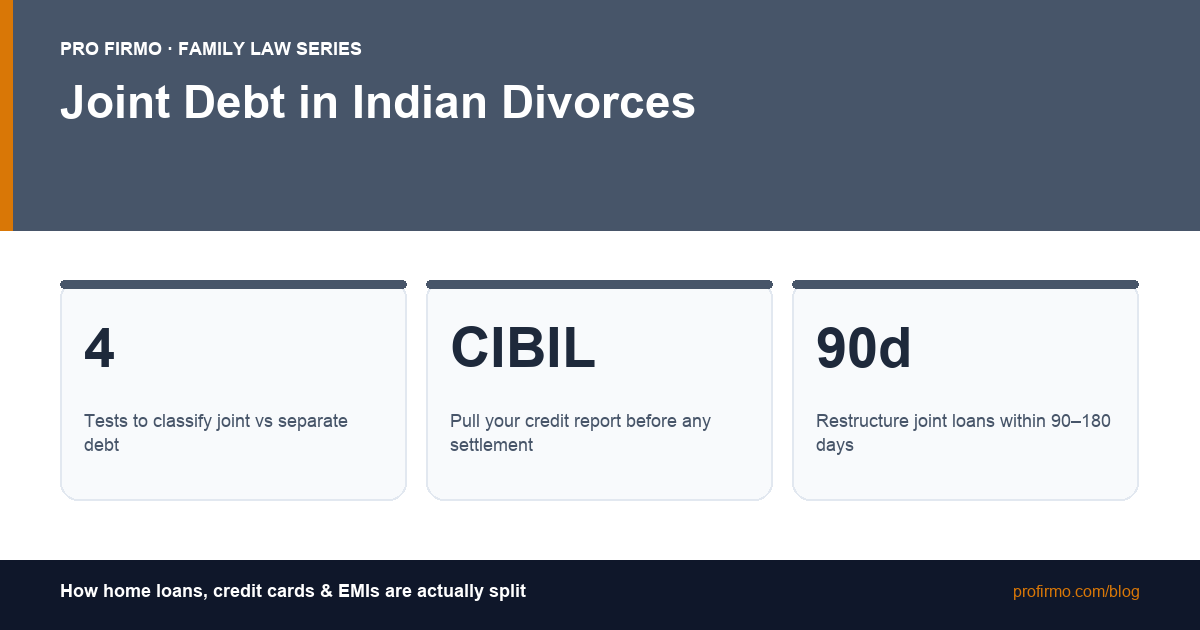
Before either side files anything, both spouses should sit down with a clean spreadsheet and list every liability. Pulling a CIBIL report on yourself is the easiest way to make sure nothing has been forgotten or hidden. The report shows every loan and credit account in your name, the balance, and the EMI.
For each entry, note four things:
- Whose name is on the paperwork? Single borrower, co-borrower, guarantor.
- When was the loan taken? Pre-marriage debt is almost always separate.
- What was the money spent on? Document it — bank statements, invoices, property registration papers.
- Who has been making the EMI payments? Look at the source account for the last 24 months.
This four-point picture is what every family-court judge will eventually ask for. Having it ready saves months.
The home loan — the biggest single question
For most middle-class Indian couples, the home loan is the largest joint debt by a wide margin. There are typically three ways forward:
- One spouse buys out the other. The retaining spouse refinances the loan in their sole name (a "balance transfer with substitution"), pays the leaving spouse for their share of the equity, and takes over the EMIs.
- Sell the property, settle the loan, split the rest. Cleanest mathematically; messiest emotionally, especially when children are involved.
- Co-own with one occupying. The property stays in joint names, one spouse lives there, both keep paying the EMI. Common as an interim arrangement; risky as a permanent one because the leaving spouse is still on the hook if the staying spouse defaults.
The lender does not care about your settlement agreement. If both names are on the loan and one stops paying, the bank can pursue either party. A divorce decree does not automatically remove a name from a loan — that requires a fresh agreement with the bank. Never rely on a verbal promise that "I'll take over the EMIs." Get the loan restructured in writing before the settlement is signed.
Hidden debt — the issue nobody likes to mention
Sometimes a spouse discovers, mid-divorce, that there are loans they never knew about. A personal loan taken to fund a side venture. A second credit card with a large balance. A loan against gold the family thought was in the locker.
This is more common than people admit, and it's why most matrimonial lawyers will insist on a full financial-affidavit exchange early in the case. Each spouse files an affidavit listing every asset, every account, every debt. Lying on it is a contempt-of-court offence. Even so, a careful look at the last 36 months of bank statements, ITRs, and Form 26AS often surfaces things the affidavit missed — large unexplained outflows, EMI debits to unfamiliar accounts, sudden tax-saving deductions linked to home loans you didn't know existed.
For high-value cases (say, ₹50 lakhs and above in joint assets and debts), engaging a forensic accountant — not just a lawyer — is increasingly common in Mumbai, Bangalore, and Delhi family courts.
Writing the settlement so it actually holds
A divorce settlement agreement (sometimes called a Memorandum of Understanding, or MoU) is the document that will govern your post-divorce financial life. On the debt side, it should:
- List every joint debt by lender, account number, current balance, and EMI.
- Specify which spouse is responsible for each going forward.
- Include an indemnity clause — if the spouse taking responsibility for a debt defaults, and the lender comes after the other spouse, the first spouse will pay the other back for any amount collected.
- Set a deadline for restructuring joint loans into single names (typically 90 to 180 days post-decree).
- Note the consequences of missing the restructuring deadline (forced sale, balance transfer, etc.).
Once the family court signs off, the MoU becomes part of the decree. It's enforceable as a court order — non-compliance can be punished as contempt.
A note on credit scores
One quiet harm of badly-handled joint debt is what happens to your CIBIL score. If your ex-spouse misses EMIs on a loan that still has your name on it, your credit score drops along with theirs. People realise this two years later, when a new home loan or car loan gets rejected. Build the joint-loan-restructuring step into the settlement timeline; check your CIBIL report 6 months after the decree to confirm your name has come off.
When to bring in a lawyer (and when not to)
Couples splitting amicably with small, well-documented debts can often draft the MoU themselves and have a lawyer review it. The moment you find yourself disagreeing about whose name is on what, or one spouse is reluctant to share financial papers, get separate lawyers. Not the same lawyer "to save costs" — that's how settlements get challenged later for conflict of interest.
The cost of a careful debt clause in your MoU is a few thousand rupees of legal time. The cost of getting it wrong — a defaulted joint loan, a bad credit score, a fresh round of litigation — is measured in lakhs and years.
This article is general information about Indian family law and is not legal advice for your specific case. Loan agreements, settlement terms, and tax treatment of debt repayment vary; consult a family lawyer in your jurisdiction before acting.
Found this useful? Share it.