
Walk into any matrimonial lawyer's chamber in Mumbai or Bengaluru today, and you will find a question being asked that wasn't asked five years ago: "Can we sign a prenup?" The person asking is usually a 28-to-35-year-old professional, often with their own business or significant assets, sometimes a returning NRI, sometimes both spouses-to-be together. The mood is matter-of-fact. The cultural taboo around the question has, in urban India, mostly melted.
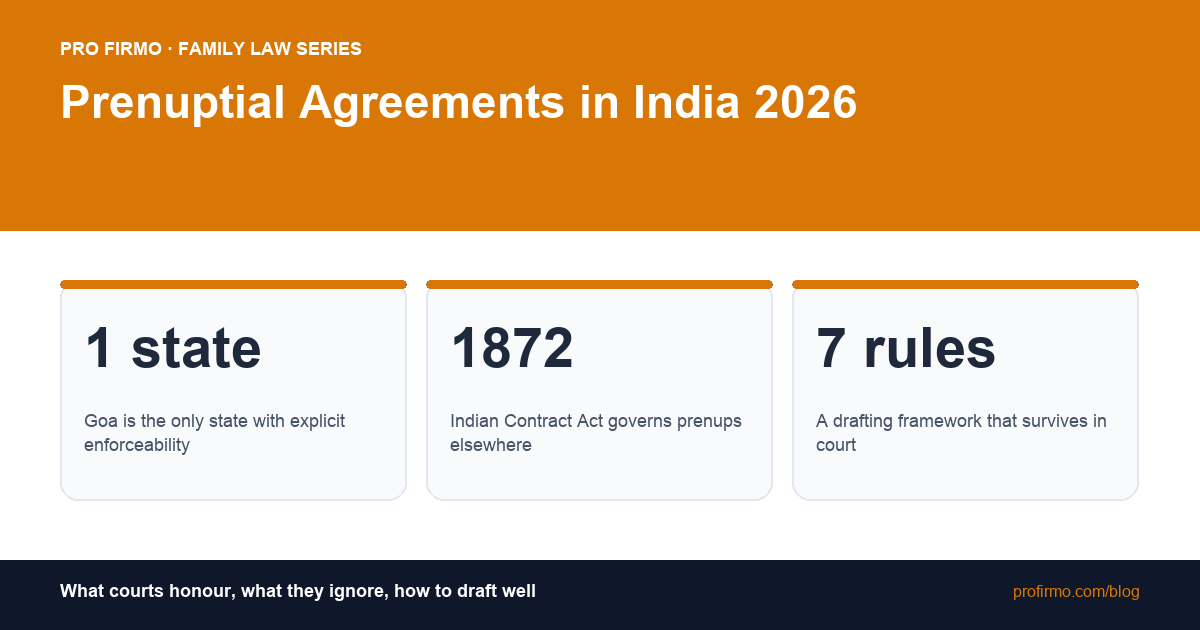
The legal answer is more nuanced than the cultural mood suggests. India does not have a Prenuptial Agreement Act. The Hindu Marriage Act, the Special Marriage Act, the Indian Christian Marriage Act, and the Parsi Marriage and Divorce Act are all silent on the subject. The Indian Contract Act, 1872 is the framework courts fall back on — and Section 23 of that Act has historically been used to strike down agreements seen as "against public policy."
But the picture in 2026 is significantly more permissive than it was even five years ago. Let's lay out where things actually stand.
Goa: the one Indian state where prenups are unambiguously legal
Goa is the exception. Under the Portuguese Civil Code, 1867 — which continues to apply in Goa, Daman, and Diu post-Liberation — Article 1096 expressly allows spouses to enter into a "convenção antenupcial" (antenuptial convention) before solemnisation of marriage. The agreement is registered, governs the marital property regime, and is fully enforceable in Goan courts.
If you are getting married in Goa, the prenup is a real, working legal instrument. For everyone else in India, it's more complicated.
The rest of India: enforceable to a point
Outside Goa, the courts' position has evolved through a series of judgments, with the current settled view being roughly this:
- A prenup is a contract. If it satisfies the Indian Contract Act — competent parties, free consent, lawful consideration, lawful object — it is a valid contract.
- A prenup that affects property division is generally enforceable, especially where its terms are fair, both parties had independent legal advice, and the document was executed without coercion. The Calcutta High Court in Pran Mohan Das v. Hari Mohan Das and the Bombay High Court in Sunita Devendra Deshprabhu v. Sitadevi Deshprabhu have given weight to premarital agreements in property disputes.
- A prenup that tries to override statutory rights — particularly maintenance — will be ignored. Section 144 BNSS (replacing Section 125 CrPC) and the maintenance provisions of the Hindu Marriage Act are non-derogable. You cannot contract out of your spouse's right to maintenance, even with their pre-marriage signature.
- A prenup that decides child custody is not binding on the court. Custody is always decided in the child's best interest at the time, not by a document signed before the child was born.
So in practice: a well-drafted Indian prenup is a strong indication to the court of what the parties intended on property and finance, persuasive but not absolute, and entirely useless for trying to dodge statutory obligations.
What goes in a workable Indian prenup
The realistic list of things a prenup can usefully address:
- Separate property. Each spouse's pre-marriage assets — flats, investments, family inheritance, business stake — declared and ring-fenced.
- Marital property. How assets acquired jointly during the marriage will be treated and split.
- Specific gifts received during the marriage. Especially significant for families exchanging substantial wedding gifts; clarity on whether they are joint or separate.
- Business ownership. Founders' equity, sweat equity, shareholder rights — protecting the business from a contested divorce.
- Debt allocation. Who carries pre-existing loans; how new joint loans during the marriage are split.
- Lifestyle expectations. Sometimes included though typically non-justiciable — religious upbringing of children, place of residence, etc.
- Dispute-resolution clause. Mediation or arbitration first; family court second.
What not to put in (because it will be struck down):
- "Wife agrees not to claim maintenance under any circumstances." Unenforceable.
- "Custody of children will be with the father." Decided by the court, child-first.
- "No spouse may seek divorce on grounds other than mutual consent." Cannot override statutory grounds.
The drafting framework — get these seven things right
- Voluntary. No coercion. No "sign this or no wedding" two hours before the muhurat. Indian courts will look at the timing.
- Capacity. Both 18+, sound mind, not under the influence.
- Full disclosure. Every asset, every liability, every income source. A prenup based on hidden assets is no prenup at all — the deceived spouse can challenge it.
- Independent legal counsel for each side. Not the same lawyer "to save money." The whole point is that each side understood what they were signing, with independent advice.
- Written, witnessed, notarised. The Indian Contract Act doesn't require notarisation for validity, but notarisation closes off a "we never really signed this" defence.
- Registered, where possible. Registration under the Indian Registration Act is optional but adds significant weight.
- Reviewed every five years or on major life events. Children, a buyout, a windfall, a city move — any of these can make a prenup stale. Refresh it with a deed of variation.
Common objections and honest answers
"Isn't a prenup unromantic?" About as unromantic as buying life insurance, and for similar reasons. Couples who have done it report it being one of the most honest conversations about money they ever have.
"Doesn't it just protect the rich spouse?" Not necessarily. A well-drafted prenup can equally protect a stay-at-home spouse by codifying a settled financial standard, putting a floor under what they're entitled to, and removing the litigation incentive on the other side.
"Will the court honour it?" Property terms, often yes. Maintenance waivers, no. Custody, no. As a body of evidence about what the parties intended, very often yes.
"What about my parents who'll insist we don't sign one?" The cultural pushback is real and varies family to family. Many couples introduce the conversation by framing the prenup as financial transparency rather than as an exit plan — a "let's both know what we're walking into" document. Whether that lands depends entirely on the family.
What about a postnuptial agreement?
Indian courts are similarly willing to give weight to post-marriage settlement agreements (postnups), again with the limitation that statutory rights cannot be contracted away. Postnups are common where families consolidate property after a few years of marriage, or where one spouse comes into an inheritance.
Closing thought
India is in the middle of a quiet shift on prenups. The Law Commission has flagged them; the urban metros have embraced them; the courts are inching toward more consistent treatment. For now, the document does some real work — particularly on property, business, and debt — and falls silent on others. Drafted well, with independent advice, and registered, it can save a couple years of acrimony and lakhs in litigation if things go wrong. Drafted badly, it can compound the mess.
If you're considering one, treat it the way you'd treat a will: a serious legal document about your future, drafted carefully, refreshed periodically, and ideally never needed.
This article is general information about Indian contract and matrimonial law and is not legal advice for your specific situation. Prenuptial agreements are jurisdiction-specific; consult a family lawyer in your state before drafting or signing one.
Found this useful? Share it.