
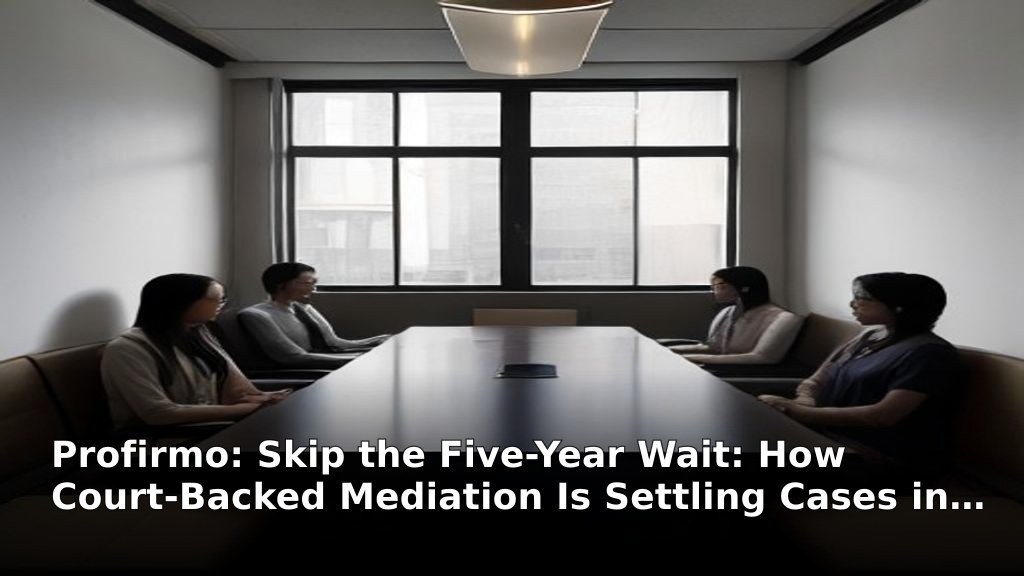
Imagine walking into court on Monday with a five-year-old property dispute, and walking out Wednesday with a signed settlement. It sounds too good to be true. But that's exactly what happened to 400 parties during the first wave of the Supreme Court's SAMADHAN SAMAROH 2026 mediation scheme—a fresh push to resolve cases without a trial.
This isn't a small experiment tucked into a corner of the system. The Court is serious enough about mediation now that it's running dedicated schemes, training mediators, and encouraging both litigants and advocates to consider settlement before they burn through years and lakhs on court hearings. If you're sitting on a dispute—commercial, property, family, even criminal—you need to understand how this works and whether it makes sense for your case.
What the SAMADHAN SAMAROH Actually Is
SAMADHAN SAMAROH isn't a new law. It's a structured mediation initiative run by the Supreme Court, in partnership with state judiciary and bar bodies, that carves out time and resources to bring parties to the negotiation table before or alongside litigation.
The scheme works like this: parties (either already in court or willing to go to court) agree to mediation. A trained neutral mediator—not a judge, not a retired judge necessarily—sits with both sides. The mediator doesn't decide who wins. They help both parties find common ground and craft their own settlement. If they reach agreement, it's recorded as a court-approved settlement. If they don't, the case goes back to normal litigation as if mediation never happened.
The speed matters because court calendars move slowly. A contested property case in a District Court can take 3 to 7 years just to reach judgment. A mediation round—if both parties show genuine intent—can close a dispute in weeks.
Why 400 Cases Closed on Day One Matters
When the scheme kicked off, the numbers were striking. Settle in one day? The answer lies in readiness. Not all 400 parties came in cold. Many had been circling settlement for months—stuck on a number, on ego, on principle. Mediation gave them permission to move. A trained mediator can reframe a deadlock into a bridge: instead of "he owes me ₹50 lakhs," it becomes "what would make you both feel fairly treated here?"
The Court recognized this. By backing mediation formally—not as a soft suggestion, but as a structured pathway—it shifted the culture. Advocates began telling clients: "We can argue this for five years, or we can talk for five weeks." When both sides see the mediator is neutral and the process is time-bound, the calculus changes.
This matters for you because it means mediation isn't just for nice people who want to preserve relationships. It works for hard commercial disputes, contested inheritances, and even some criminal matters where parties want closure instead of conviction.
Which Cases Settle Fastest
Not every dispute is equally suited to mediation. The ones that move quickly share a few traits:
- Disputes with clear value but unclear division. A ₹2-crore partnership dissolution where both sides know the business is worth ₹2 crore, but disagree on the split. Mediation can get them to "70-30 or 65-35" in days. Litigation might take years to untangle books and expert reports.
- Property and boundary quarrels. Two adjacent landowners fighting over a strip of land. The legal boundary might be clear, but mediation can bring them to a mutual fence-line that saves both the cost of enforcement and years of appeals.
- Commercial defaults and payment disputes. A supplier suing for unpaid invoices; the buyer claims quality issues. Both sides want cash or goods, not a courtroom. Mediation can reset terms—payment plan, replacement goods—faster than a contract trial.
- Some family and inheritance matters. Adult siblings deadlocked over how to partition a deceased parent's house. Courts can divide it, but mediation lets siblings craft something both can live with—one buys the other's share, or one gets the house and pays the other, or they sell and split. It preserves some dignity.
By contrast, cases that move slowly in mediation tend to be ones where:
- One party is using litigation as punishment, not problem-solving. (Rare but real.)
- The dispute hinges on a legal principle someone won't compromise on, even if it costs more to fight it out.
- One party hopes the other will simply give up or run out of money. Litigation serves that goal; mediation doesn't.
What Advocates and Clients Should Actually Do
If you're an advocate: the SAMADHAN SAMAROH scheme and similar mediation pathways are no longer optional filler talk in your case management. Clients increasingly expect you to explore settlement—it's cheaper, faster, and you can still be their warrior if mediation fails. Learn to spot settlement-ready cases early (partner disputes, unpaid loans, boundary quarrels, inheritance tangles). Get a list of empanelled mediators in your jurisdiction—these are trained neutrals recognized by the Court. When your client says "I want to settle," you now have a formal channel that carries court weight.
If you're a client: mediation isn't weakness. It's choosing your timeline instead of letting the court system choose it for you. If you've been in litigation for 2+ years and haven't reached trial yet, ask your advocate whether mediation is an option. The cost of a mediation round—typically ₹15,000 to ₹50,000 split between parties, depending on complexity—is trivial next to another year of court fees, advocate fees, and your own time. And if mediation fails, you simply resume litigation as if it never happened. Your evidence, your position, everything stays intact.
The Real Constraint: Both Sides Have to Show Up
There's one catch. Mediation works only if both parties actually want to settle or are at least willing to listen. You can't force someone to be reasonable. If the other side uses mediation as theatre—appearing in the session but refusing to budge—you've lost time and money.
The Courts know this. Recent judgments and court-backed schemes now emphasize qualified mediators (trained in real mediation, not just retired judges), clear ground rules, and time-bound sessions. If a party is clearly bad-faith, the mediator can wind up early and send the case back to court without wasting months.
What's changed is that court systems—starting with the Supreme Court through schemes like SAMADHAN SAMAROH—are making mediation the path of least resistance. They're training mediators, clearing court calendars for mediation, and making it clear to litigants: "We support you settling this yourselves." The old culture of "litigation or nothing" is finally shifting.
A Practical Path Forward
If you're holding a dispute right now—whether you're already in court or still negotiating—your next step is simple: ask whether mediation fits. If both sides have been talking but hitting a wall, if you both want closure more than vindication, if the dispute is about dividing value rather than proving fault—mediation can save you years and money. The Supreme Court has made it clear it will support you. Your advocate can connect you to an empanelled mediator. And the process, while not perfect, has just proved it can move 400 cases in one day.
That's not a miracle. That's a system finally working the way it should.
Found this useful? Share it.